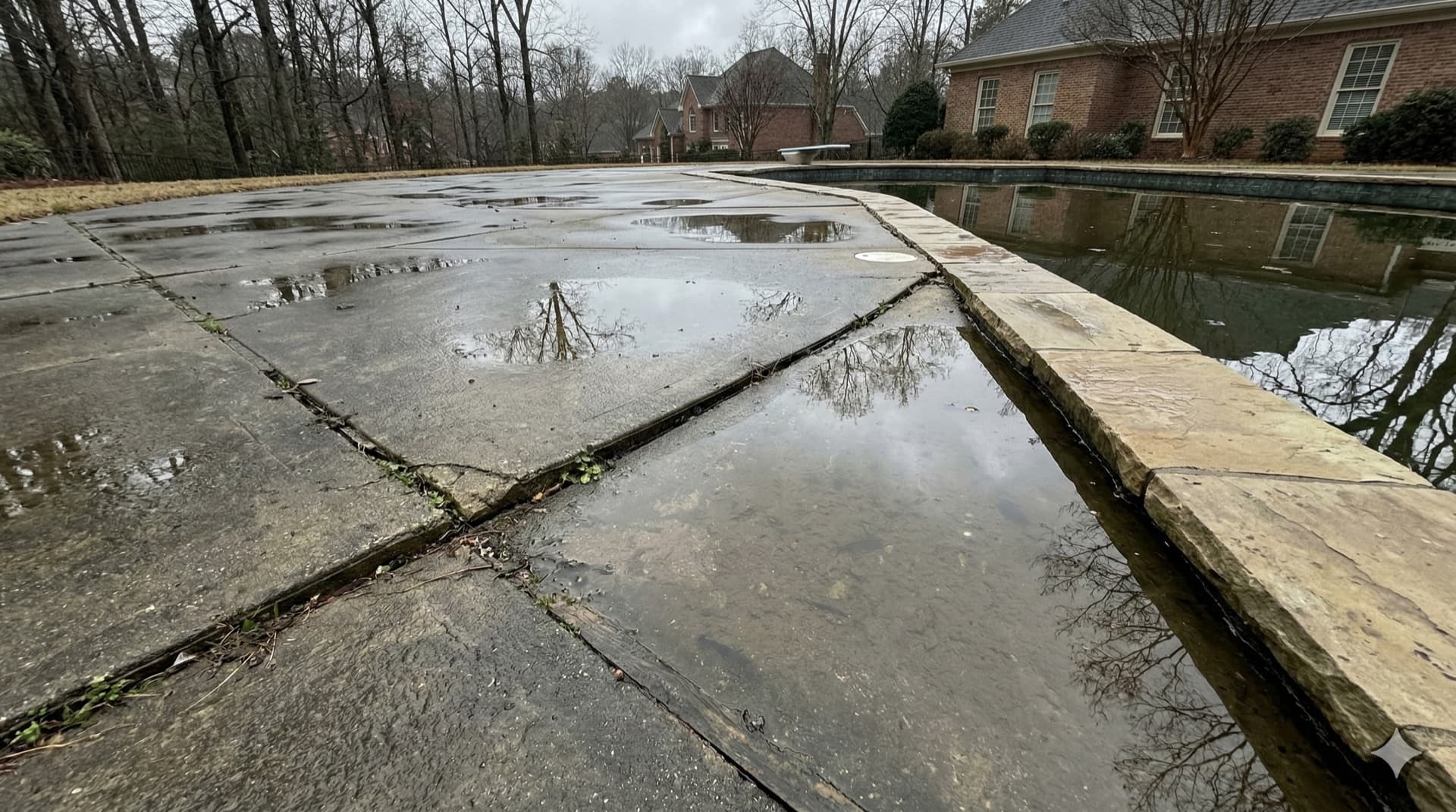
Water pooling on your deck after rain — or worse, flowing toward your pool instead of away from it — is more than an annoyance. It's a structural problem that gets worse over time, and in Metro Atlanta's climate (50+ inches of rain annually), it gets worse faster than you'd expect.
Here's what causes deck drainage problems, what can be fixed without a full replacement, and when a new deck is the right call.
Why Pool Decks Develop Drainage Problems
A properly installed pool deck slopes away from the pool at a grade of roughly 1/4 inch per foot. Water hits the deck, flows away from the pool edge, and exits through perimeter drains, yard drainage, or natural grade into the surrounding landscape.
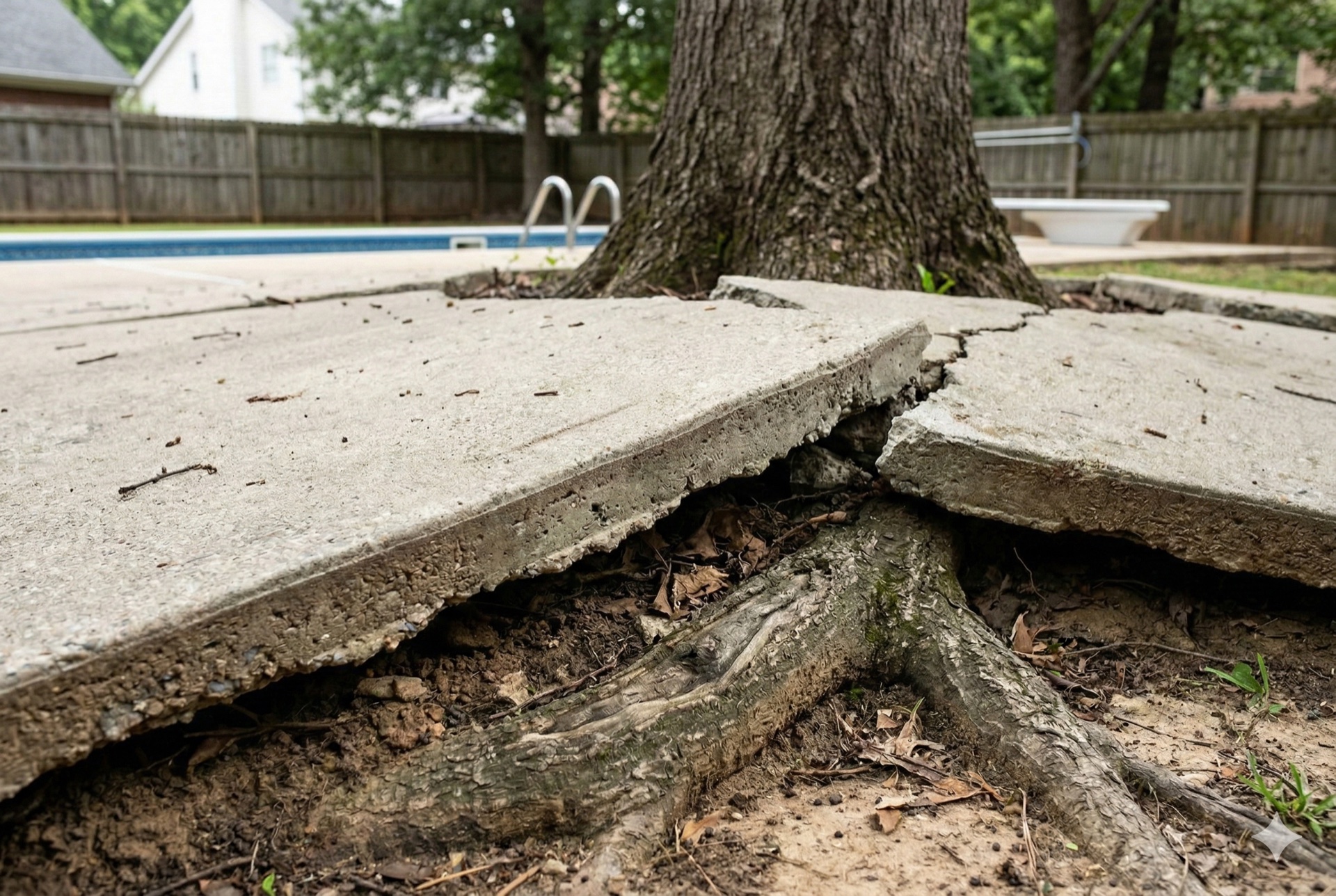
When that drainage fails, there are a few common causes:
Soil settlement. Georgia's red clay is the primary culprit in Metro Atlanta. Clay soil expands when wet and contracts when dry. Over years of this cycle, the base material under the deck shifts, and slabs settle unevenly. A slab that used to drain away from the pool now tilts toward it — or creates a low spot that holds water.
This is especially common in East Cobb and Roswell, where mature properties have been through decades of clay movement.
Tree root intrusion. Roots from mature oaks, maples, and other hardwoods grow under deck slabs and lift them unevenly. This is a Metro Atlanta reality — most suburban pools are surrounded by mature trees. The lifted slab creates a dam that traps water, and the uneven surface becomes a trip hazard.
Original installation issues. Some decks were never graded properly to begin with. If the base was compacted inadequately, if the slope was too shallow, or if drain placement was poor, the problems show up within a few years — and compound over time.
Coping and expansion joint failure. The joint between the coping and deck is a critical drainage transition. When that joint caulk fails — and it always eventually fails — water seeps under the coping and behind the pool shell. It also pools in the gap, which accelerates freeze-thaw damage to both the coping and the deck edge.
Drainage Problems You Can Fix Without Replacing the Deck
Not every drainage issue means a full deck replacement. Here are targeted fixes that work when the overall deck is structurally sound:
Slab leveling (mudjacking or foam injection). If specific slabs have settled but the deck surface itself is intact, a specialty contractor can inject material under the slab to raise it back to grade. Cost is typically $500 to $1,500 per slab section — significantly less than replacement. This works for isolated settlement, not widespread failure.
Channel drain installation. If water is pooling in a specific low area, cutting in a channel drain (a narrow trench drain with a grate) can redirect flow. Cost is $1,000 to $3,000 depending on length and complexity. This treats the symptom, not the underlying grade problem, but it's effective when the pooling is localized.
Expansion joint replacement. Failed caulk joints between deck slabs and between the deck and coping can be cut out and re-sealed with proper flexible sealant. This is maintenance-level work — $500 to $1,500 for a typical pool perimeter — but it stops water infiltration at the most vulnerable transition points.
Grinding and surface correction. Minor unevenness (a raised edge, a slight lip at a joint) can sometimes be ground down to restore drainage flow. Limited in scope but effective for trip hazards and small pooling areas.
When You Need a New Deck
Targeted fixes work when the problem is localized. When the deck has systemic drainage failure, replacement is the more practical (and ultimately cheaper) solution:
Widespread settlement. If more than 30% of the deck slabs have settled or shifted, leveling individual sections becomes an expensive game of whack-a-mole. The base material has failed, and no amount of patching addresses that.
Structural cracking. Hairline surface cracks are cosmetic. Cracks that go through the full slab thickness, that offset (one side higher than the other), or that grow visibly over time indicate structural movement. These slabs need replacement, not repair.
Water flowing toward the pool consistently. If the deck's overall grade has reversed — water flows toward the pool instead of away — the entire drainage plane needs to be re-established. That means removing the deck, regrading the base, and installing new material with proper slope.
Multiple problem areas adding up. When you're quoting repairs for slab leveling here, a channel drain there, joint replacement everywhere, and grinding in several spots — the total cost approaches deck replacement, but without a new base or a warranty. At some point, starting fresh makes more financial sense.
What a Proper Deck Replacement Involves
A deck replacement that solves drainage problems (not just cosmetic ones) includes:
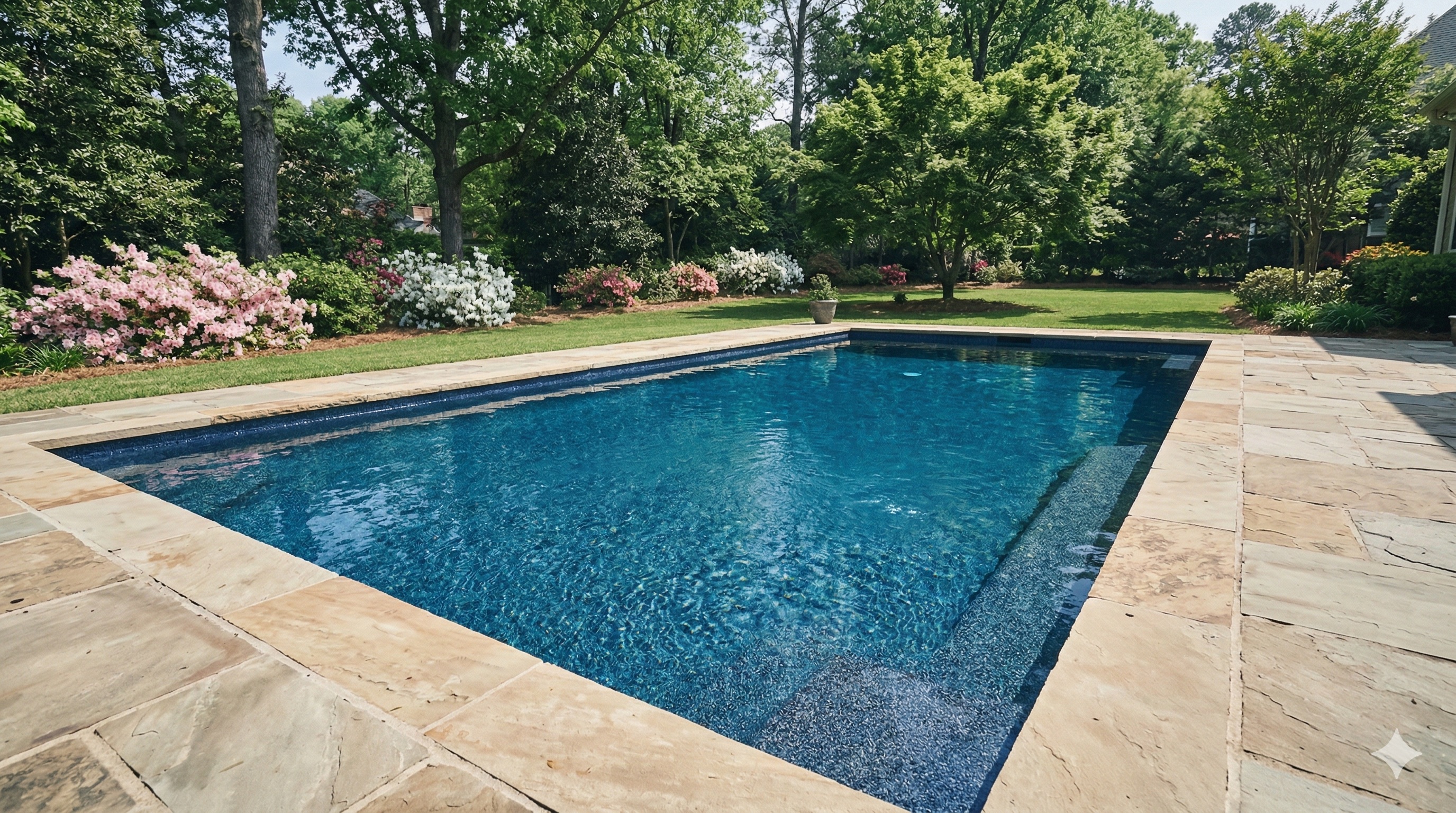
Full removal of the existing deck. Old concrete, old base material, everything down to native soil.
Base preparation. This is the critical step. The base gets excavated, regraded to establish proper drainage slope away from the pool, and compacted in lifts with appropriate base material (typically crushed stone or compactable gravel). In Metro Atlanta's clay conditions, this step determines whether the new deck drains properly for the next 20 years.
Drainage infrastructure. Depending on the site, this may include channel drains at the pool edge, perimeter French drains, or subsurface drainage tied to the property's stormwater system.
New deck surface. Pavers — travertine or concrete — are the standard for replacement because they offer better drainage characteristics than poured concrete. Individual pavers can shift and be reset without breaking, and the joints between pavers allow minor water infiltration into the base rather than pooling on the surface.
Proper joints and transitions. New expansion joints at the coping-deck connection, slab-to-slab transitions, and perimeter edges. These get filled with flexible sealant rated for pool environments.
Cost Expectations
Targeted repairs (leveling, drain installation, joint work): $1,000 to $5,000 depending on scope.
Full deck replacement with pavers: $15 to $30 per square foot installed, including base work. For a typical Metro Atlanta pool with 600 to 1,000 square feet of deck, that's $9,000 to $30,000. Travertine pavers sit at the higher end of the range; concrete pavers are more moderate.
The cost varies significantly based on existing conditions — how much excavation is needed, whether drainage infrastructure is required, and site access. A pool on a flat lot with easy access is a different project than one with grade changes and tight backyard access.
The Connection to Pool Renovation
Deck drainage problems rarely exist in isolation. If your deck is failing, there's a reasonable chance your pool surface, coping, and equipment are approaching the end of their service life too — they're all the same age, exposed to the same conditions.
If you're facing a deck replacement and your pool is also due for resurfacing, doing both projects together saves meaningful money. The crew is already on site, the pool is already drained (for resurfacing), and the deck work coordinates with coping replacement rather than working around it.
This is one of the strongest arguments for tackling a full renovation rather than doing deck work standalone — the labor overlap saves 15% to 25% on the combined project versus doing them separately.
Getting an Assessment
If your deck is holding water, creating trip hazards, or directing rainwater toward the pool, the first step is figuring out whether you're dealing with a repair situation or a replacement situation. That requires an on-site assessment — photos and descriptions don't capture grade, slope, or base conditions accurately.
During a consultation, we check slab levels, identify settlement patterns, evaluate coping-to-deck transitions, and determine whether the drainage problem is localized or systemic. You'll get a clear recommendation with specific pricing.
When Repair Made More Sense Than Replacement
A homeowner in Roswell was convinced they needed a full deck replacement — their 2004-era brushed concrete deck had standing water along the entire north side after every rain. Two contractors had quoted full replacement at $22,000 and $26,000.
A closer look with a level told a different story. The problem was concentrated in three specific slab sections that had settled roughly 3/4 inch toward the pool — all in an area where a large water oak's root system ran under the deck. The remaining 75% of the deck was structurally sound with proper drainage grade.
Instead of full replacement, targeted work addressed the issue: foam injection to level the three settled slabs ($2,200), root barrier installation to prevent future lifting ($800), channel drain installation along the north pool edge to capture the redirected flow ($1,800), and expansion joint replacement around the full perimeter ($1,100). Total: $5,900 — roughly 25% of the cheapest full replacement quote. Two years later, the deck drains properly, no new settlement has occurred, and the homeowner saved over $16,000.
The American Society of Civil Engineers (ASCE) standards for exterior flatwork drainage specify a minimum slope of 1/4 inch per foot away from adjacent structures, with positive drainage toward collection points — the same specification we verify during every deck assessment, whether the project is a targeted repair or a full replacement.
Reach out through the contact form or call to schedule an assessment — We'll tell you whether you're looking at a repair or a replacement, and what each option costs.
Ready to Talk About Your Pool?
Get a free, no-obligation consultation from Cornerstone Pool & Remodel.
Request a Free Quote