Pool Renovation FAQ
Answers to common questions about pool renovation services across Metro Atlanta.
Pool Resurfacing
The most common signs are rough texture (you can feel it on your feet or it snags swimwear), visible staining that won't respond to chemical treatment, surface cracks or flaking, and persistent algae growth in areas that should be smooth. If your pool is more than 7 years old and you're noticing any of these, it's worth having the surface evaluated.
Most residential resurfacing projects take 5 to 7 days from drain to fill. That includes draining, surface preparation, finish application, curing, and refilling. Our team manages the full timeline and coordinates every phase so you have one point of contact throughout the project — not multiple crews working on different schedules.
Absolutely. Resurfacing is the best time to change your water color. The finish you choose — and its specific color blend — determines how the water looks. We'll walk you through samples and help you visualize how each option translates in your specific pool based on its depth, sun exposure, and surrounding landscape.
Not always, but it's often the smartest time to do it. Since the pool is already drained and the perimeter is exposed, replacing coping or waterline tile during a resurface avoids the cost and disruption of a separate project later. We'll give you an honest assessment of whether your existing coping and tile are worth keeping.
Replastering is a type of resurfacing — it specifically refers to applying a new plaster finish. 'Resurfacing' is the broader term that covers all interior finishes, including plaster, pebble, and quartz. When someone says they need to 'replaster' their pool, what they usually mean is they need a new interior surface, which may or may not be plaster depending on what finish they choose.
Typically 7 to 10 days after the pool is refilled. The new surface needs time to cure and the water chemistry needs to be carefully balanced during that initial period. We provide detailed startup instructions and monitor the water chemistry in the first week to make sure the finish cures properly.
Coping
The clearest signs are visible cracking, stones that are lifting or shifting when you press on them, gaps where grout or mortar has washed out, and discoloration or staining that won't clean up. If your coping is original to a pool that's 15 or more years old, it's likely approaching the end of its useful life even if it still looks passable from a distance.
Yes. Coping replacement is a standalone project that doesn't require draining the pool or touching the interior finish. Many of our clients replace their coping independently — either because the surface is still in good condition or because they're not ready for a full renovation yet.
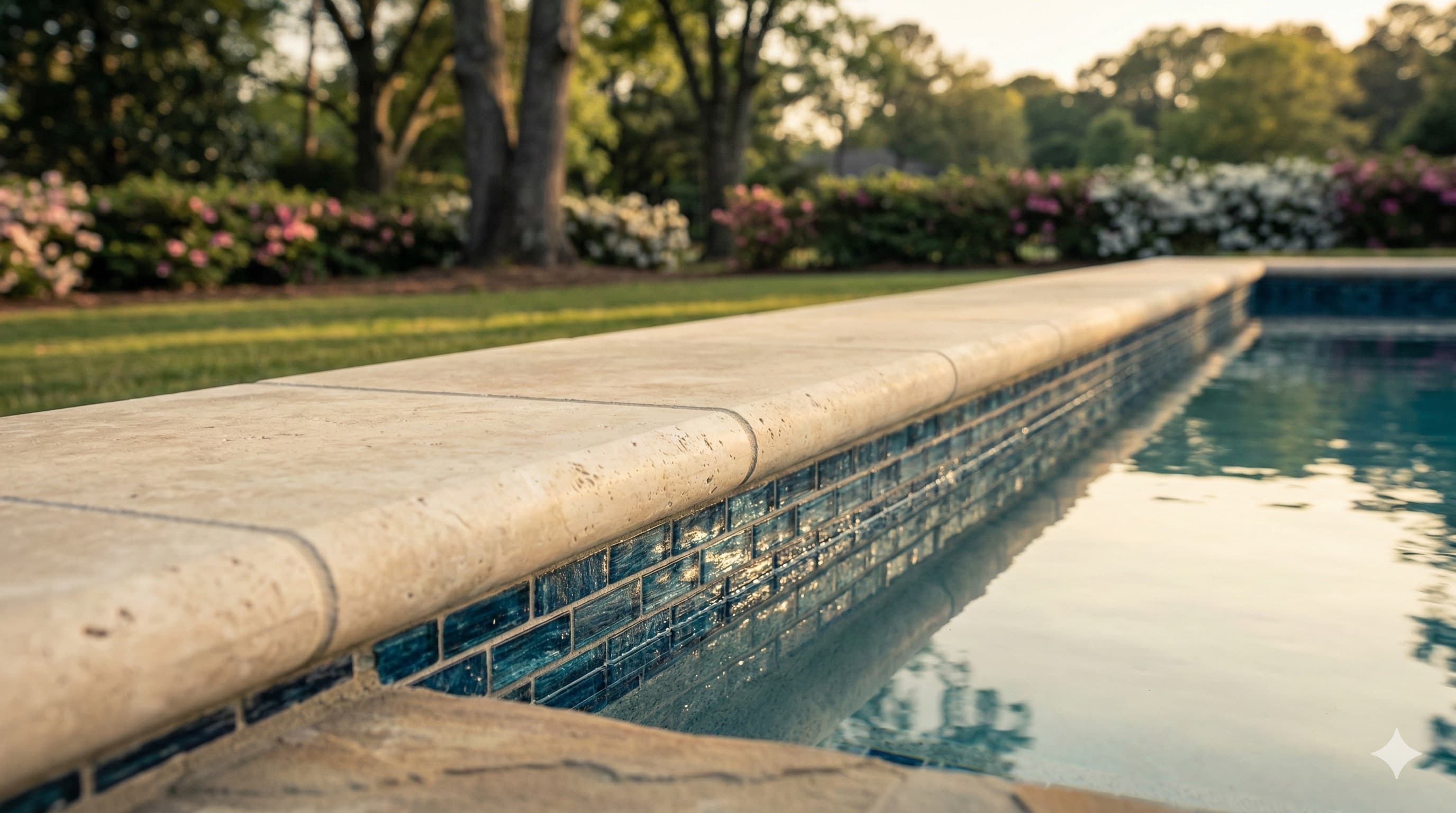
This is one of the most important decisions in the project, and it's something we walk through with you on-site. The coping needs to complement both the pool tile below and the deck material beyond it — it's the visual bridge between the two. We'll bring samples, look at your existing hardscape, and help you narrow the options to materials and colors that tie everything together.
Not necessarily — and in many cases, a deliberate contrast looks better than a forced match. A travertine coping against a paver deck, for example, creates a clean visual border that defines the pool's shape. We'll help you decide whether matching, complementing, or contrasting is the right approach for your specific backyard.
Most residential coping projects take 2 to 4 days depending on the pool's perimeter length, the complexity of the shape (curves and radius sections take more time), and the material being installed. Natural stone and flagstone generally require more cutting and fitting time than pavers or brick.
It depends on the material. Travertine is one of the coolest options underfoot — its natural density and light color reflect heat rather than absorbing it. Darker natural stones and some pavers will get warmer. We always factor heat performance into our recommendations, especially for pool edges where bare feet are constant.
Tile
The most common signs are cracked or missing tiles, tiles that are loose or popping off the wall, heavy calcium buildup that won't clean off, and grout that's deteriorated or washed out. If you're seeing any of these — or if the tile is simply dated and dragging down the look of an otherwise well-maintained pool — it's time to evaluate a replacement.
Yes. Waterline tile can be replaced as a standalone project without draining the pool fully — the water level just needs to be lowered below the tile line. That said, if your surface is also nearing the end of its life, doing both at the same time during a full drain is more efficient and avoids paying for two separate mobilizations.
It starts with where the tile is going (waterline, floor, feature wall) and what look you're after. From there, we help narrow the options based on material performance, color coordination with your coping and surface finish, and budget. We'll walk you through samples and can show you how specific tiles look installed in actual pool settings — not just on a display board.
For most waterline and feature applications, yes. Glass is nonporous, meaning it resists staining and calcium deposits better than ceramic or porcelain. It reflects light beautifully underwater, and it holds its color permanently — it won't fade from sun or chemical exposure. The upfront cost is higher, but the longevity and visual impact make it the best long-term value for most pool tile applications.
A standard waterline tile replacement typically takes 2 to 3 days. Larger projects — full floor tile, feature walls, or custom mosaics — take longer depending on the scope and complexity. Mosaic work in particular is time-intensive due to the precision layout and hand-cutting involved. We'll give you a clear timeline during the planning phase based on exactly what's being done.
Sometimes — but it depends on the original tile. If the existing tile is still in production or a close match is available, a partial replacement is possible. In many cases, though, the color of the existing tile has shifted over years of chemical and sun exposure, and even an exact match from the manufacturer won't blend seamlessly with the aged original. We'll always be upfront about whether a partial replacement will look right or whether a full replacement is the better call.
Pool Deck
It comes down to the condition of the existing substrate. If the concrete slab is structurally sound — no major settling, heaving, or deep cracking — an overlay or resurfacing is usually a viable option. If there are significant structural issues, grade problems, or drainage that's flowing toward the pool instead of away from it, a full tear-out and rebuild is the better investment. We'll assess the existing deck during your consultation and give you an honest recommendation.
It depends on the scope. A resurfacing overlay on an existing slab can be done in 3 to 5 days. A paver or stone installation over the immediate pool surround typically takes 5 to 10 days. Larger projects that include extended patios, walkways, and full backyard hardscape can take 2 to 4 weeks. We'll provide a detailed timeline during the planning phase based on your specific project.
It depends on the material and color. Travertine is naturally one of the coolest options — its density and light color reflect heat rather than absorbing it. Light-colored concrete pavers also perform well. Spray-deck and cool-deck coatings are specifically designed to reduce surface temperature. Darker materials and standard poured concrete will be warmer. We always factor heat performance into our material recommendations, especially in Atlanta's climate.
In most cases, yes — though not simultaneously. The pool can remain filled during a deck renovation, but the work area needs to be clear and safe, which means the pool won't be usable on active work days. If the deck renovation is part of a larger project that includes resurfacing (which requires draining), the entire scope is coordinated so the pool is out of commission for the shortest time possible.
This is one of the most important design decisions in the project, and it's something we walk through with you before any materials are ordered. The deck, coping, and tile need to work together visually — whether that means matching, complementing, or deliberately contrasting. We bring samples on-site so you can see materials in the actual light and context of your backyard, not just under showroom lighting.
A properly installed paver system — with adequate base compaction, correct depth of gravel and sand, and appropriate edge restraints — is extremely stable. Minor settling can occur over time, especially in areas with heavy traffic or significant tree root activity, but individual pavers can be lifted, the base corrected, and the pavers reset without replacing anything. That repairability is one of the biggest long-term advantages of a paver deck over poured concrete.
Structural Modifications
In the vast majority of cases, your existing pool can be modified. The concrete shell is an engineered structure designed to last decades — it can support tanning ledges, spa additions, depth changes, and wall extensions when the work is done correctly. Full pool replacement is almost never necessary unless the shell has catastrophic structural failure, which is rare. We'll assess your pool and give you an honest answer about what's realistic.
It depends on the scope. A tanning ledge addition might take 1 to 2 weeks. A spa addition or major reshaping can take 3 to 6 weeks. Multiple modifications done as part of a larger renovation are coordinated into a single project timeline. We'll provide a detailed schedule during planning so you know what to expect.
That's entirely a function of how the work is done. When the structural build, the surface finish, the tile, and the coping are all planned and executed as one cohesive project, the modification should look like it was always part of the original design. That's the standard we hold ourselves to — if you can tell where the old pool ends and the new work begins, we haven't done our job.
Most pools can accommodate a spa addition, but the specifics — size, placement, plumbing integration, pool equipment requirements — depend on your pool's existing layout, the available space around it, and the capacity of your current pool equipment. Some spa additions require upgrading the heater, pump, or plumbing to handle the additional volume and jet demand. We'll evaluate all of this during the planning phase.
Almost always, yes. Structural modifications require draining the pool, and so does resurfacing. Doing both during the same drain-down saves time, money, and disruption. It also ensures that the new structural surfaces and the existing pool interior are finished in the same session, so everything matches perfectly. If you're considering a resurface in the near future, it makes sense to plan any structural changes at the same time.
Tanning ledges, by a significant margin. They're the modification that changes daily pool use the most — suddenly, there's a place to lounge at water level, set the kids up in a few inches of water, or sit with your feet in the pool without committing to a full swim. Spa additions are the second most popular, followed by raised walls with water features.
Pool Equipment
Most pool equipment has a useful life of 8 to 12 years depending on the component and how well it's been maintained. Signs include frequent repairs, declining performance, unusual noise, increasing energy costs, and age. If your pool equipment is more than 8 years old and you're planning a renovation, it's worth evaluating whether it makes sense to upgrade now rather than dealing with failures after the renovation is complete.
Yes, substantially. Variable-speed pumps reduce pump energy costs by 50 to 70 percent. Salt systems cut ongoing chlorine purchases. LED lighting reduces energy consumption dramatically compared to incandescent fixtures. Modern heaters and heat pumps are significantly more efficient than older models. The upfront investment in modern pool equipment typically pays for itself within a few years through reduced operating costs.
It depends on your current pool equipment. Some existing pumps, heaters, and lights can be integrated into a new automation system with compatible relays and actuators. Others — particularly older single-speed pumps and non-compatible heaters — may need to be replaced to work with modern automation. We'll evaluate your existing setup and give you an honest assessment of what can be integrated and what needs to be upgraded.
Efficiency and integration. During a renovation, the plumbing is already being accessed, the equipment pad is already part of the work scope, and any electrical or gas line work can be coordinated with the build. Upgrading later means a separate mobilization, separate plumbing and electrical work, and the risk that the new pool equipment needs modifications to work with the recently installed plumbing — all of which adds cost and complexity.
If you value softer water, lower chemical maintenance, and reduced chlorine odor, a salt system is a worthwhile upgrade. The water quality difference is noticeable — softer on skin and eyes, less chemical smell, and more stable sanitizer levels. The system does require a compatible surface finish and periodic cell replacement, but the ongoing convenience and reduced chemical costs make it one of the most popular pool equipment upgrades we do.
Yes. All electrical work — including wiring for automation panels, lighting circuits, heater hookups, and any panel upgrades needed to support new pool equipment — is performed by licensed electricians as part of our project. We don't leave the electrical work for the homeowner to coordinate separately.
Still Have Questions?
Let's Talk.
We're happy to walk you through any aspect of the renovation process. Reach out for a free, no-obligation conversation.